
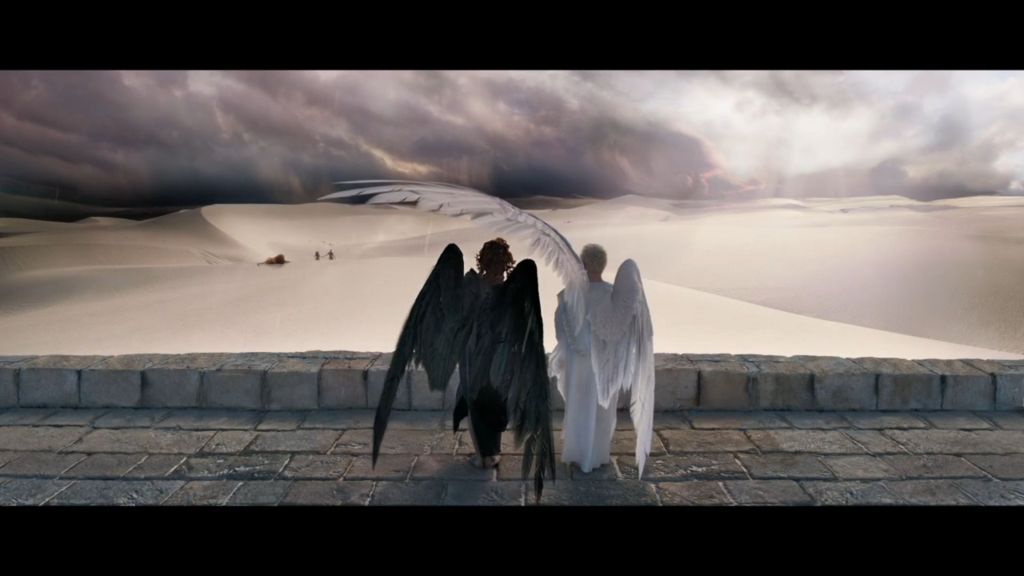
© Amazon Prime Video (Screenshot Episode 1, time code: 00:05:56)
Elsa-Margareta Venzmer
German Abstract: Queerbaiting ist eine Marketing-Technik und Erzählstrategie, die in der deutschsprachigen Forschungslandschaft kaum bekannt ist, aber auch in der internationalen Forschung bisher nur wenig Beachtung findet. Mithilfe von Queerbaiting versuchen FernsehproduzentInnen durch homoerotische oder romantische Handlungsstränge, die zwei oder mehrere gleichgeschlechtliche Charaktere betreffen, ein LGBTQIA+-affines Publikum anzuziehen, ohne tatsächlich eine queere Beziehung darzustellen. In dem Beitrag soll gezeigt werden, dass Sentimentalität eine entscheidende Rolle bei Queerbaiting und der Darstellung von modernen Männerfreundschaften im Fernsehen spielt. Hierfür wird analysiert, wie Fernsehserien über ihre ästhetische Gestaltung und narrativen Motive Queerbaiting inszenieren. Exemplifiziert wird dies anhand der ersten Staffel der Amazon-Prime-Serie Good Omens.
How It All Started
A few years ago, I stumbled upon an article posted in the fanfiction.net Facebook group in which the author Chris Winkle outlines „Twelve Signs a Storyteller Is Building Romantic & Sexual Chemistry.“ Some of those signs are, for instance, „Staring & Close Eye Contact,“ „Activities Associated With Dating,“ or „Onlookers Assume They’re Dating“ (Winkle 2020). And all I could think was: She is right! It is worth noting that her article does not focus on romantic films or comedies, but movies and TV series that feature, among other themes, friendships between characters of the same sex, such as The Lord of the Rings, Harry Potter, Teen Wolf, Sherlock, and Good Omens. Although I would not call it building a romantic and sexual chemistry in the context of such movies and TV series, I would clearly call it queerbaiting.
Judith Fathallah defines queerbaiting „as a strategy by which writers and networks attempt to gain the attention of queer viewers via hints, jokes, gestures, and symbolism suggesting a queer relationship between two characters, and then emphatically denying and laughing off the possibility“ (Fathallah 2015, p. 491). In this article, I intend to explore and extend the list of „signs“ or „hints“ mentioned by Winkle and Fathallah that indicate queerbaiting, as well as show that sentimentality plays a crucial role in queerbaiting and the representation of modern same-sex friendships on television. This is exemplified by the first season of the Amazon Prime series Good Omens (2019–; showrunner: Neil Gaiman) and its two main characters, the angel Aziraphale and the demon Crowley – whom Good Omens fans have lovingly named ‚Ineffable Husbands.‘
A few brief words about the plot: In Good Omens, the angel Aziraphale and the demon Crowley try to prevent the arrival of the Antichrist and the imminent Armageddon, thus the final battle between heaven and hell – which represents a witty homage to the horror film The Omen (1976). In spite of being representatives of heaven and hell, the two of them find themselves enjoying life on earth – and each other’s company, as one can see in the representation of their friendship.
Other Characters Mistake the Protagonists for a Couple
Let us start off with Winkle’s sign „Onlookers Assume They’re Dating.“ In various scenes of the Amazon Prime series Good Omens, other characters mistake Aziraphale and Crowley for a couple. In the second episode, the two of them investigate what happened to the lost antichrist after his birth in an old hospital. In one moment, Crowley pins Aziraphale against a wall after the angel accidentally insulted the demon by calling him „nice.“ As they face each other very closely and nuzzle each other, Sister Agnes eventually interrupts the two of them by saying, „Sorry to break up an intimate moment,“ thinking that the two of them in fact have an intimate moment.
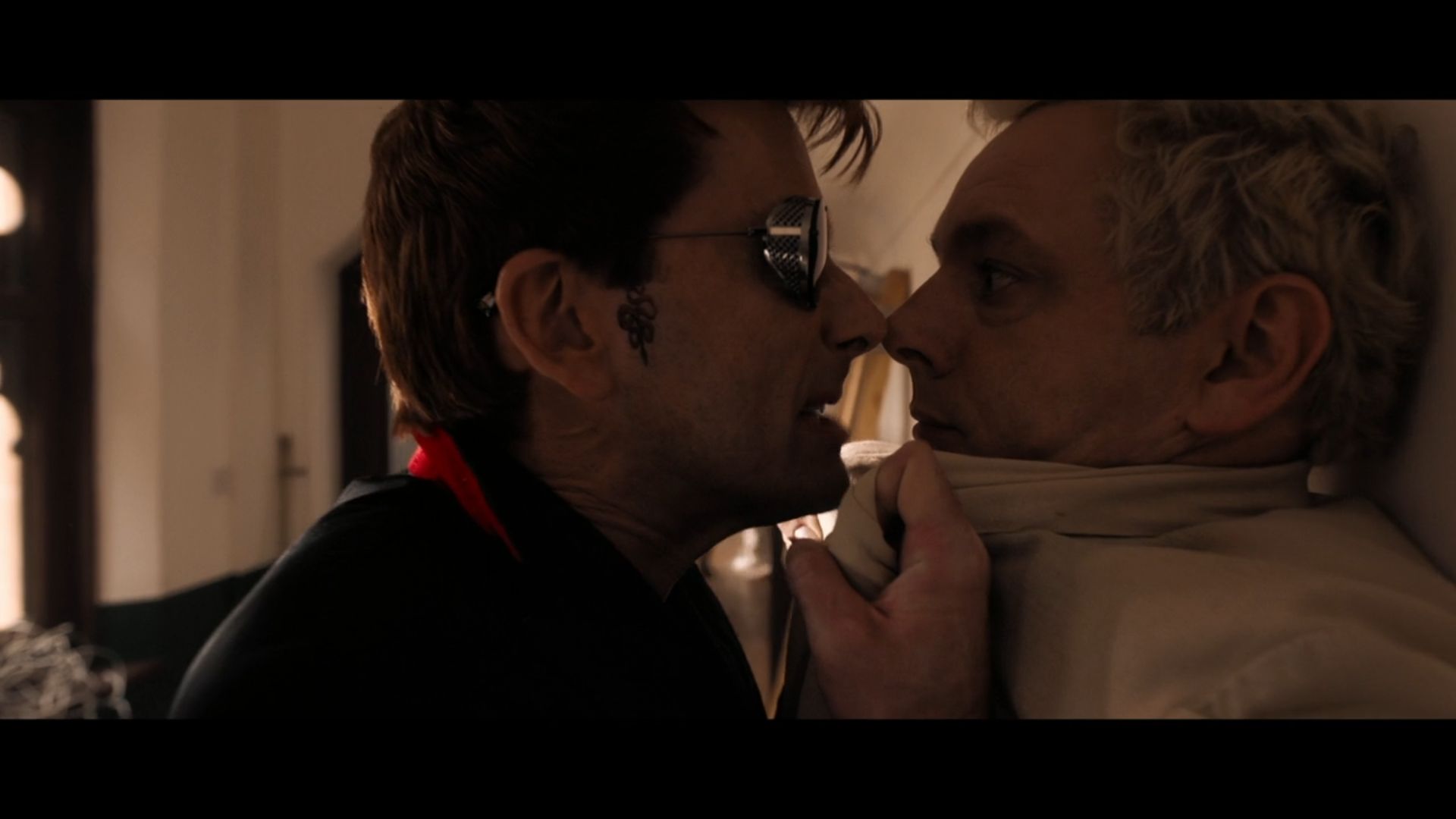
© Amazon Prime Video (Screenshot Episode 2, time code: 00:38:32)
In the fourth chapter, a pedestrian also assumes that the two of them are lovers. When Crowley gives a melodramatic (totally not) break-up speech in the middle of the street, saying that when he flees Earth he „won’t even think about“ Aziraphale (*sob*), a pedestrian walking by gives Aziraphale the advice, „I’ve been there. You’re better off without him,“ assuming that he just witnessed a fight between a couple.
Last but not least, again in episode four, Aziraphale’s angel comrades call Crowley his „boyfriend in the dark glasses,“ so not just his „friend.“ It seems like other people can sense the deep connection that Crowley and Aziraphale have, according to the motto: The world knew before they did.
These scenes are not only packed with queerbaiting hints, but also with sentimentality. For example, in the break-up scene in the middle of the street – aside from a break-up scene being quite sentimental in itself – Crowley first begs Aziraphale that they should flee before the war on earth starts. Aziraphale wants to stay on earth, but tells Crowley before he leaves: „I forgive you.“ To understand this deeply sentimental line: In an earlier scene of the third episode, Crowley tells Aziraphale that, if heaven were to win the war between heaven and hell, he, as a demon, would never be forgiven and probably be killed. In saying „I forgive you,“ Aziraphale tries to save the life of his (boy-)friend. After their argument, Aziraphale then gazes lovingly at him when Crowley leaves angry. Which brings me to Winkle‘s next hints: „Staring & Close Eye Contact“ in combination with „Activities Associated With Dating.“
Visual Hints: The Male-Male Gaze and Romantic Activities
Unlike Winkle, I would not call it „Staring & Close Eye Contact,“ though; I would call it gazing – and a copious amount of gazing there is. For example, in the cold open of the third chapter, Crowley saves Aziraphale from Nazis during the Second World War. However, he does not only save him – in that sequence he also protects Aziraphale’s precious books because he knows how much they mean to him (Aziraphale being a bookstore owner and all). After Crowley saves his books, Aziraphale keeps gazing at him thankfully and suggestively, while sentimental instrumental music starts playing in the background.
One other example: In the very last sequence, Crowley and Aziraphale have lunch together after the earth is saved. After they toast „to the world,“ Aziraphale again keeps gazing at Crowley with heavy breathing. Crowley and Aziraphale having lunch, dinner, or late night drinking sessions are also „Activities Associated With Dating“ that Winkle mentions. Besides the gazing, the set design also gives the spectator the impression that they are on a date – like candles suggesting a candlelit dinner, or the fact that they drink wine and champagne.
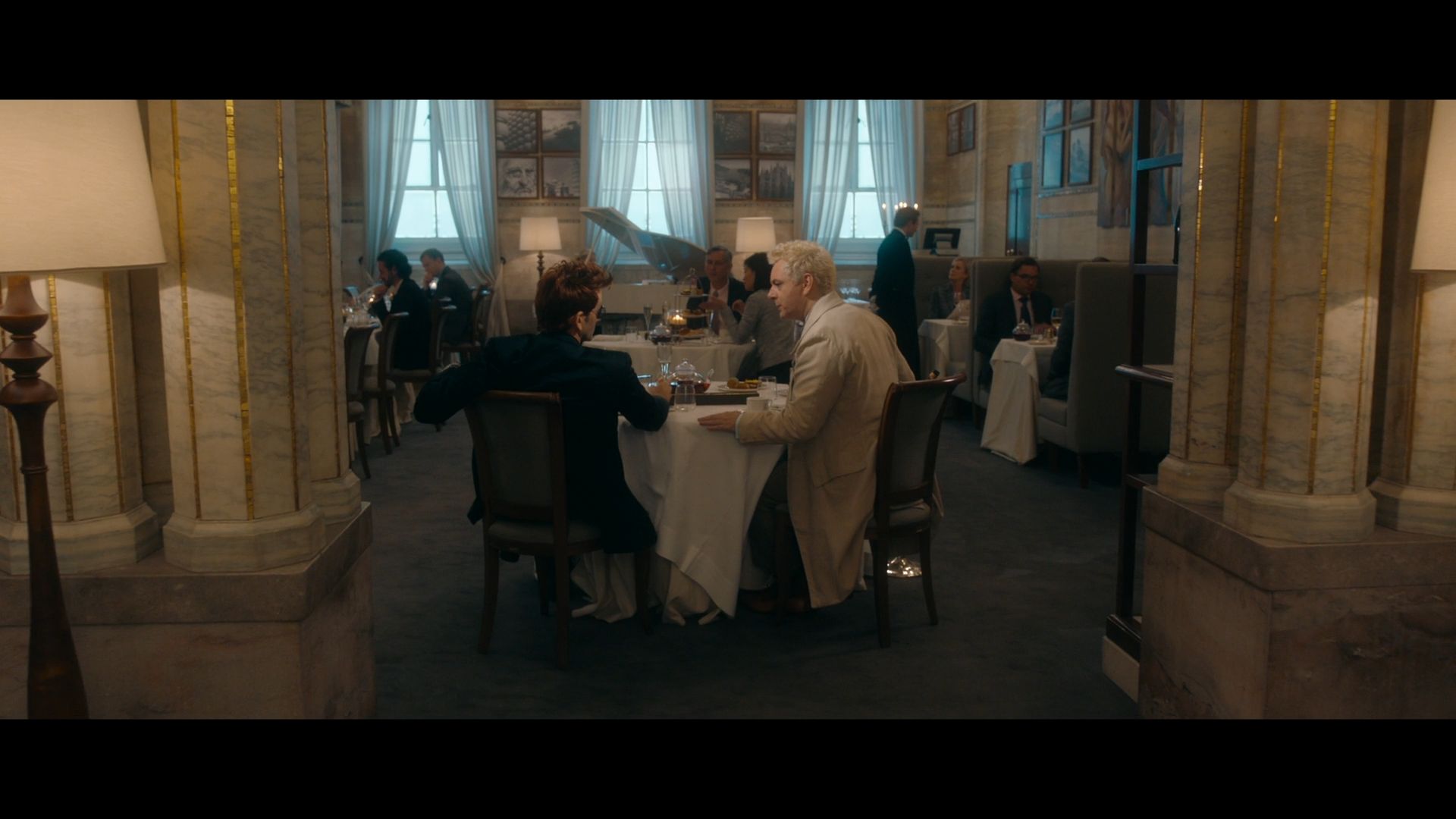
© Amazon Prime Video (Screenshot Episode 6, time code: 00:51:39)
In that last sequence, you can also see a white piano playing in the background of the restaurant. As the camera zooms out, it looks like the white wing of the piano is hovering above Crowley and Aziraphale having lunch. There is a lot of symbolism in that scene, since something similar happened in the first episode of Good Omens, when Crowley and Aziraphale meet in the Garden of Eden for the first time. As it starts to rain in the Garden of Eden, Aziraphale protects Crowley from the rain with his white angel wing (see the picture above) – a symbolization of their instant connection, which concludes in the last sequence with the wing of the white piano.
Suggestive or Ambiguous Dialogue
One hint for queerbaiting that Winkle does not mention in her list is suggestive or ambiguous dialogue. Some of the dialogue of the series does not leave much room for interpretation, but quite obviously describes Aziraphale’s and Crowley’s relationship. In the cold open of the third chapter, that shows their friendship in different stages throughout history since they met in the Garden of Eden, Aziraphale eventually agrees to a favor that Crowley asked of him (providing him with holy water for protection). Crowley then responds to Aziraphale’s gift by saying, „After everything you said,“ clearly moved. In that scene, both sit in Crowleys car and Crowley then offers to drop Aziraphale off anywhere he wants to go. Aziraphale responds to Crowley’s ‚proposal‘ with the words, „You go too fast for me, Crowley,“ which clearly reflects the current stage of their relationship.
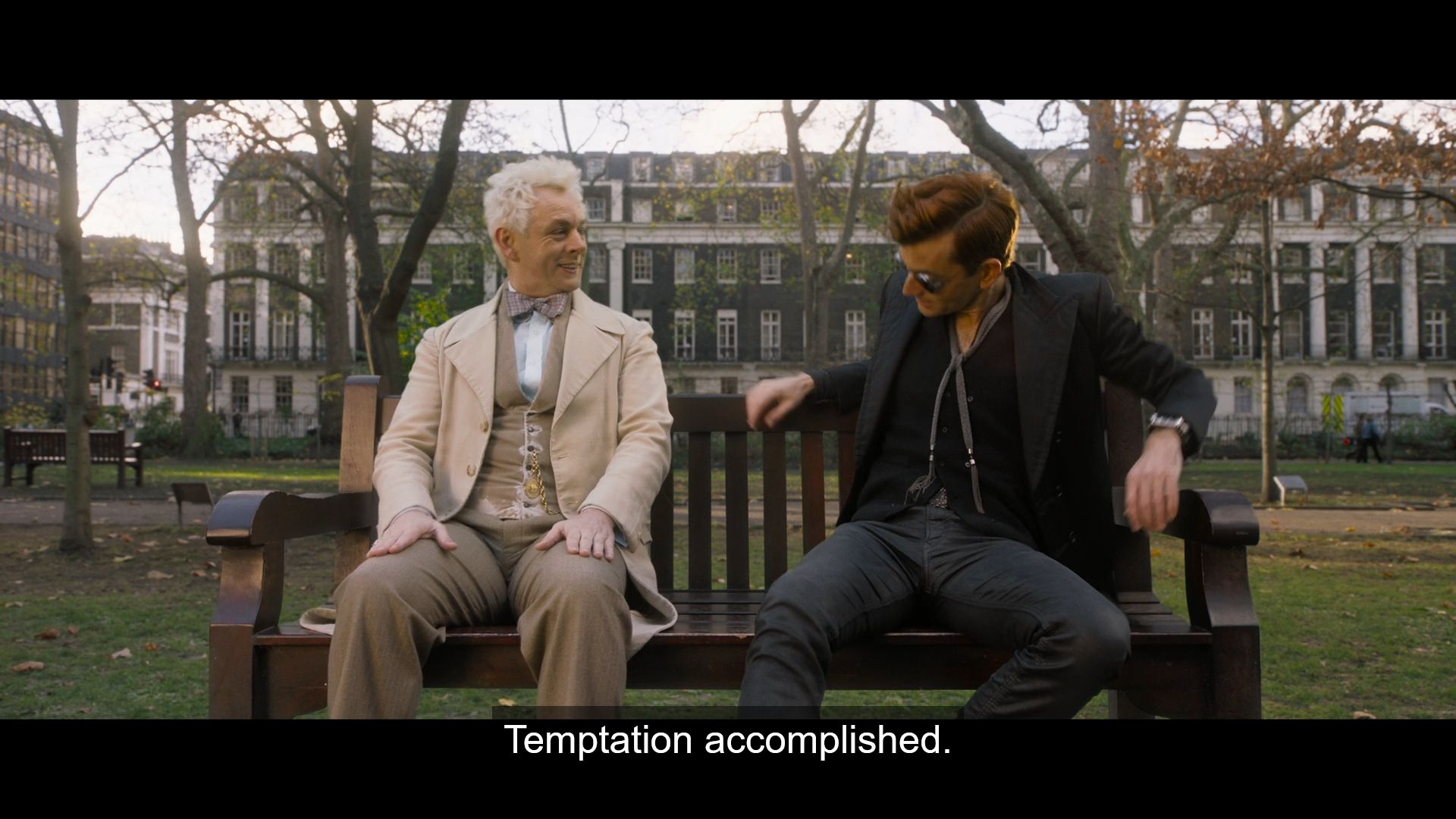
© Amazon Prime Video (Screenshot Episode 6, time code: 00:50:19)
In the third, fourth, and last episode, there are also some subtle-not-so-subtle lines that show that they can not live without each other. In the third and fourth episode, Crowley suggests two times to Aziraphale that they can „run away together,“ when the war between heaven and hell starts – a sentimental line that often appears in love stories. In the last episode, Aziraphale then wants Crowley to „come up with something,“ so the world does not end, and motivates him successfully with the words, „or I’ll never talk to you again.“ Crowley immediately feels inspired by Aziraphale’s threat and stops time to prevent the (not)-apocalypse and the loss of his angel. Like in love stories, it is the two of them (literally) against the world. And there is also a ‚forbidden love‘ angle, since, as an angel and a demon, they are on opposite sides.
In terms of sentimentality – other than the connection to love story tropes – as a spectator, you can literally see the deep feelings they have for one another in these scenes. When Crowley asks Aziraphale in a gazebo to run away with him, Aziraphale is first touched and repeats after him „go off together?“ with a smile on his face, but ultimately turns Crowley down by saying „it’s over“ between them. One can see then in Crowley’s frozen facial expression (even with sunglasses on) that Aziraphale’s words clearly hurt him, and he stays quiet for a while before he walks off feeling rejected and wishing Aziraphale a „nice doomsday.“ The scene concludes by Aziraphale crying and standing alone in the gazebo.
There is much more suggestive or ambiguous dialogue in the series, like Aziraphale telling Crowley, „Get thee behind me, foul fiend,“ nicknames like „angel,“ or the overuse of the words „temptation“ and „ineffable.“ For instance, when Aziraphale responds to Crowley’s lunch invitation at the end of series by saying „temptation accomplished.“ However, listing all those lines would exceed the scope of this article.
Conclusion
There are many other hints that indicate queerbaiting, such as musical cues, physicality, themes of fatherhood, or the presentation of an ‚odd couple‘ that repeat themselves in buddy TV series like Sherlock, Stranger Things, Supernatural, Our Flag Means Death, or – another Neil Gaiman series – The Sandman. And of course each series has its individual hints, for instance, the wing theme in Good Omens. In this blog post, my goal was to open a dialogue about queerbaiting and to give an example of what a systematized analysis of queerbaiting can look like – by finding and exploring those hints – and the role sentimentality plays in framing queerbaiting.
A next step could be to explore sentimental queerbaiting also in the discourse surrounding television texts by examining, for example, interviews of media producers like authors and actors. I recently read a tweet of showrunner Neil Gaiman, in which he states about Good Omens: „Whatever Crowley and Aziraphale are, it’s a love story“ (Wilson 2019). Amen. Or rather, as Aziraphale with a queer eye would say it: „Temptation accomplished.“
References
Fathallah, Judith (2015): Moriarty’s Ghost: Or the Queer Disruption of the BBC’s Sherlock. In: Television & New Media 16, no. 5: 490–500.
Good Omens. UK 2019–. BBC Studios, Amazon Prime Video.
Wilson, Angel (2019): Neil Gaiman Calls ‘Good Omens’ a “Love Story”. URL: https://thegeekiary.com/neil-gaiman-calls-good-omens-a-love-story/65986. Retrieved 25 May 2023.
Winkle, Chris (2020): Twelve Signs a Storyteller Is Building Romantic & Sexual Chemistry. URL: https://mythcreants.com/blog/twelve-signs-a-storyteller-is-building-romantic-sexual-chemistry/. Retrieved 25 May 2023.


 Fernsehmomente
Hinterlasse einen Kommentar